
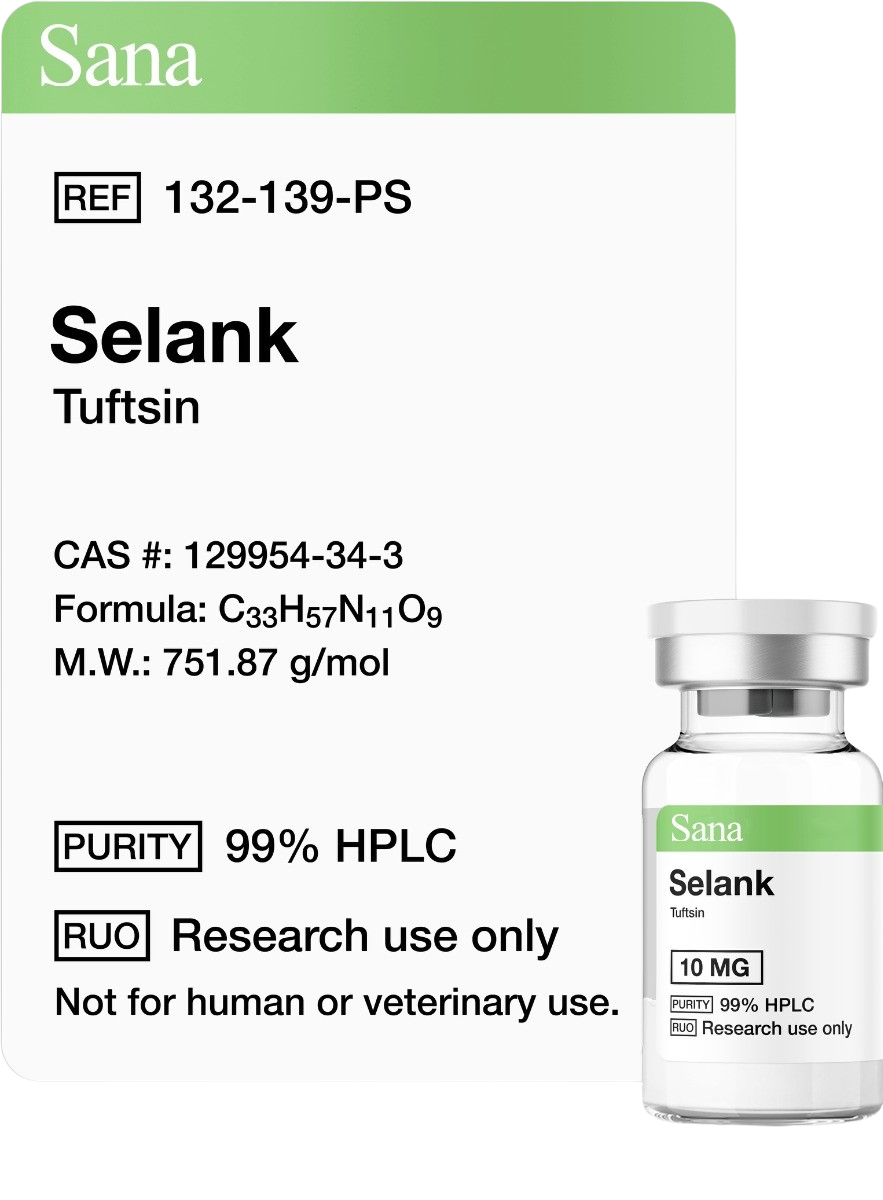
Selank 10mg
$55.00
Selank is a synthetic peptide studied for its role in neurological signaling, stress-related research, and cognitive pathway exploration. Developed as a high-purity, research-grade formulation for controlled laboratory use.
In Stock
Selank is a synthetic peptide derived from a naturally occurring immune peptide fragment. It has gained attention in research settings for its involvement in neurological signaling and its interaction with neurotransmitter pathways.
At Sana, Selank is manufactured under strict quality control standards to ensure purity, stability, and consistency. This compound is commonly used in laboratory and educational research focused on neurological processes and behavioral science.
Biochemical Characteristics
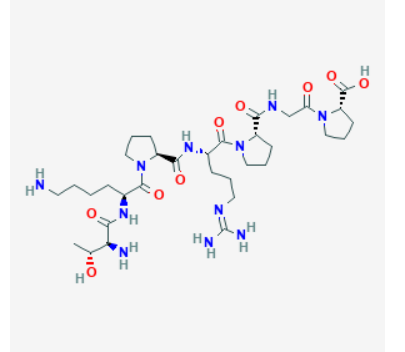
Sequence: Thr-Lys-Pro-Arg-Pro-Gly-Pro
Molecular Formula: C33H57N11O9
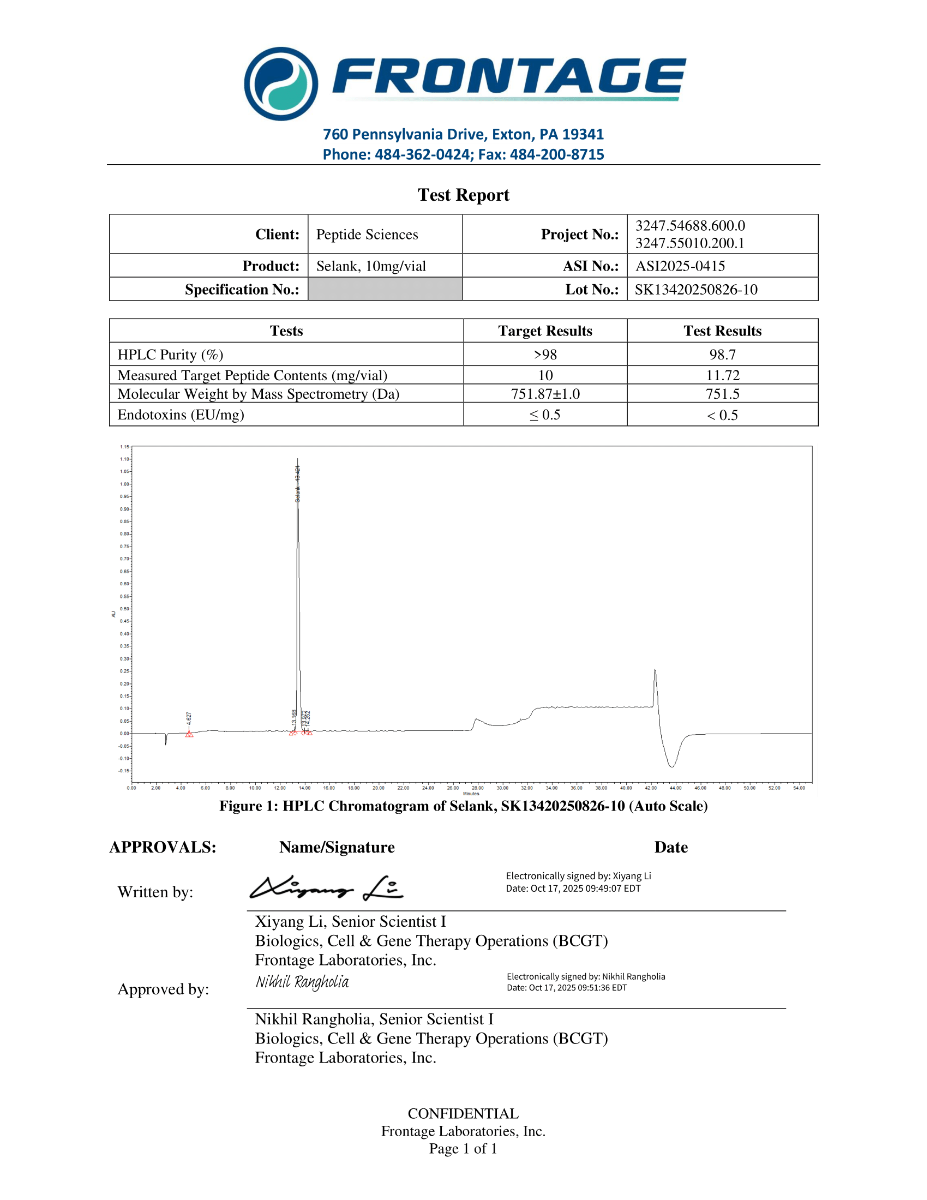
Molecular Weight: 751.87 g/mol
CAS Number: 129954-34-3
Synonyms: Selanc
Research Applications
Selank is utilized in preclinical research environments to examine peptide-driven modulation of molecular signaling networks. Common experimental applications include:
- Gene expression profiling related to neurotransmitter-associated pathways
- Investigation of GABAergic signaling components in rodent neural tissue
- Analysis of enkephalin-degrading enzyme activity in biochemical assays
- Immune-related gene transcription studies involving cytokines and chemokines
- Evaluation of peptide stability and receptor-associated signaling dynamics
Pathway / Mechanistic Context
Mechanistic studies indicate that Selank participates in modulation of intracellular signaling cascades associated with GABAergic neurotransmission, monoaminergic balance, and immune-related transcriptional regulation. In animal models, Selank exposure has been associated with altered expression of genes involved in receptor signaling, enzymatic degradation pathways, and cytokine-mediated communication.
Additional investigations have examined Selank-related modulation of enkephalinase activity, suggesting an indirect influence on endogenous peptide turnover and receptor-ligand availability at the molecular level.
Preclinical Research Summary
Preclinical studies involving Selank have primarily utilized rodent models and in vitro biochemical systems. Published data describe changes in transcriptional profiles of neural and immune tissues, including genes associated with inflammatory signaling, neurotransmitter receptor modulation, and stress-responsive pathways.
Animal-based experiments have further evaluated Selank as a tool for studying peptide-mediated regulation of gene networks involved in neuroimmune communication. These investigations emphasize pathway-level observations rather than organism-level outcomes.
Form & Analytical Testing
Selank is supplied as a synthetic research peptide. Analytical verification typically includes high-performance liquid chromatography (HPLC) and mass spectrometry (MS) to confirm identity, purity, and molecular mass. These analytical methods support consistency and reproducibility in laboratory research workflows.
Article Author
The above literature was researched, edited and organized by Dr. Logan, M.D. Dr. Logan holds a doctorate degree from Case Western Reserve University School of Medicine and a B.S. in molecular biology.
Scientific Journal Author
Dr. Petr Slominsky‘s 169 research works with 803 citations. 12 of those papers pertain to the examination of Selank’s diverse, multifaceted effects e.g. anxiety reduction, changes in the transcription profile of the hippocampus, and changes in expression of the genes for chemokines, cytokines, and their receptors. Dr. Slominsky is particularly interested in the epigenetic effects of Selank and other disease-state pathologies.
Dr. Petr Slominsky is being referenced as one of the leading scientists involved in the research and development of Selank. In no way is this doctor/scientist endorsing or advocating the purchase, sale, or use of this product for any reason. There is no affiliation or relationship, implied or otherwise, between Peptide Sciences and this doctor. The purpose of citing the doctor is to acknowledge, recognize, and credit the exhaustive research and development efforts conducted by the scientists studying this peptide. Dr. Petr Slominsky is listed in [7] under the referenced citations.
Referenced Citations
- Volkova et al., “Selank Administration Affects the Expression of Some Genes Involved in GABAergic Neurotransmission,” Front. Pharmacol., vol. 7, Feb. 2016. [PubMed]
- Kasian et al., “Peptide Selank Enhances the Effect of Diazepam in Reducing Anxiety in Unpredictable Chronic Mild Stress Conditions in Rats,” Behavioural Neurology, 2017. [Online]. Available: https://www.hindawi.com/journals/bn/2017/5091027/.
- A. Zozulya et al., “The inhibitory effect of Selank on enkephalin-degrading enzymes as a possible mechanism of its anxiolytic activity,” Bull. Exp. Biol. Med., vol. 131, no. 4, pp. 315–317, Apr. 2001. [PubMed]
- Y. Sokolov, V. K. Meshavkin, N. V. Kost, and A. A. Zozulya, “Effects of Selank on behavioral reactions and activities of plasma enkephalin-degrading enzymes in mice with different phenotypes of emotional and stress reactions,” Bull. Exp. Biol. Med. [PubMed]
- N. Uchakina et al., “[Immunomodulatory effects of selank in patients with anxiety-asthenic disorders],” Zh. Nevrol. Psikhiatr. Im. S. S. Korsakova, vol. 108, no. 5, pp. 71–75, 2008. [PubMed]
- A. Zozulia et al., “[Efficacy and possible mechanisms of action of a new peptide anxiolytic selank in the therapy of generalized anxiety disorders and neurasthenia],” Zh. Nevrol. Psikhiatr. Im. S. S. Korsakova, vol. 108, no. 4, pp. 38–48, 2008. [PubMed]
- Kolomin, M. Shadrina, L. Andreeva, P. Slominsky, S. Limborska, and N. Myasoedov, “Expression of inflammation-related genes in mouse spleen under tuftsin analog Selank,” Regul. Pept., vol. 170, no. 1–3, pp. 18–23, Oct. 2011. [PubMed]
- I. Agapova et al., “[Effect of semax on the temporary dynamics of brain-derived neurotrophic factor and nerve growth factor gene expression in the rat hippocampus and frontal cortex],” Mol. Genet. Mikrobiol. Virusol., no. 3, pp. 28–32, 2008. [PubMed]
- P. Semenova, I. I. Kozlovskiĭ, N. M. Zakharova, and M. M. Kozlovskaia, “[Experimental optimization of learning and memory processes by selank],” Eksp. Klin. Farmakol., vol. 73, no. 8, pp. 2–5, Aug. 2010. [PubMed]
- A. Kolomin et al., “[c],” Zh. Vyssh. Nerv. Deiat. Im. I. P. Pavlova, vol. 63, no. 3, pp. 365–374, Jun. 2013.
- P. Semenova, M. M. Kozlovskaya, N. M. Zakharova, I. I. Kozlovskii, and A. V. Zuikov, “Effect of selank on cognitive processes after damage inflicted to the cerebral catecholamine system during early ontogeny,” Bull. Exp. Biol. Med., vol. 144, no. [PubMed]
- V. Kost et al., “[Semax and selank inhibit the enkephalin-degrading enzymes from human serum]],” Bioorg. Khim., vol. 27, no. 3, pp. 180–183, Jun. 2001. [Springer]
ALL ARTICLES AND PRODUCT INFORMATION PROVIDED ON THIS WEBSITE ARE FOR INFORMATIONAL AND EDUCATIONAL PURPOSES ONLY.
The products offered on this website are furnished for in-vitro studies only. In-vitro studies (Latin: in glass) are performed outside of the body. These products are not medicines or drugs and have not been approved by the FDA to prevent, treat or cure any medical condition, ailment or disease. Bodily introduction of any kind into humans or animals is strictly forbidden by law.
RUO Disclaimer
For Laboratory Research Only. Not for human use, medical use, diagnostic use, or veterinary use.
Storage Information
-
Store in a cool, dry environment
-
Protect from heat, moisture, and light
-
Keep container securely sealed when not in use
-
Handle using standard laboratory safety protocols
Related products
In Stock